
Today we're publishing The Multiplayer AI Manifesto.
This document comes from our experience building Superconductor, and from many conversations with our customers and other teams about their AI transformations.
Why we need this manifesto
In these discussions, the same thing tends to come up: the productivity gains from single-player AI are not translating into proportional improvements in organizational velocity.
We think a large part of the reason is that we have regressed from modern collaborative experiences such as Google Docs to endless copy-and-pasting to and from each other's single-player AI chats and agent sessions.
Fixing this, and making AI properly multiplayer, will also go a long way to improving security concerns. As AI agents become increasingly powerful, they cannot be allowed to operate without supervision in insecure environments, where sensitive data they may gain access to can end up on the public Internet or in malicious hands. A proper org-wide cloud sandboxing and network firewall solution, which is required for a multiplayer experience, is necessary.
By the way, in a Harvard Business School study with 776 professionals at Procter & Gamble, the best-performing configuration was "Teams + AI."
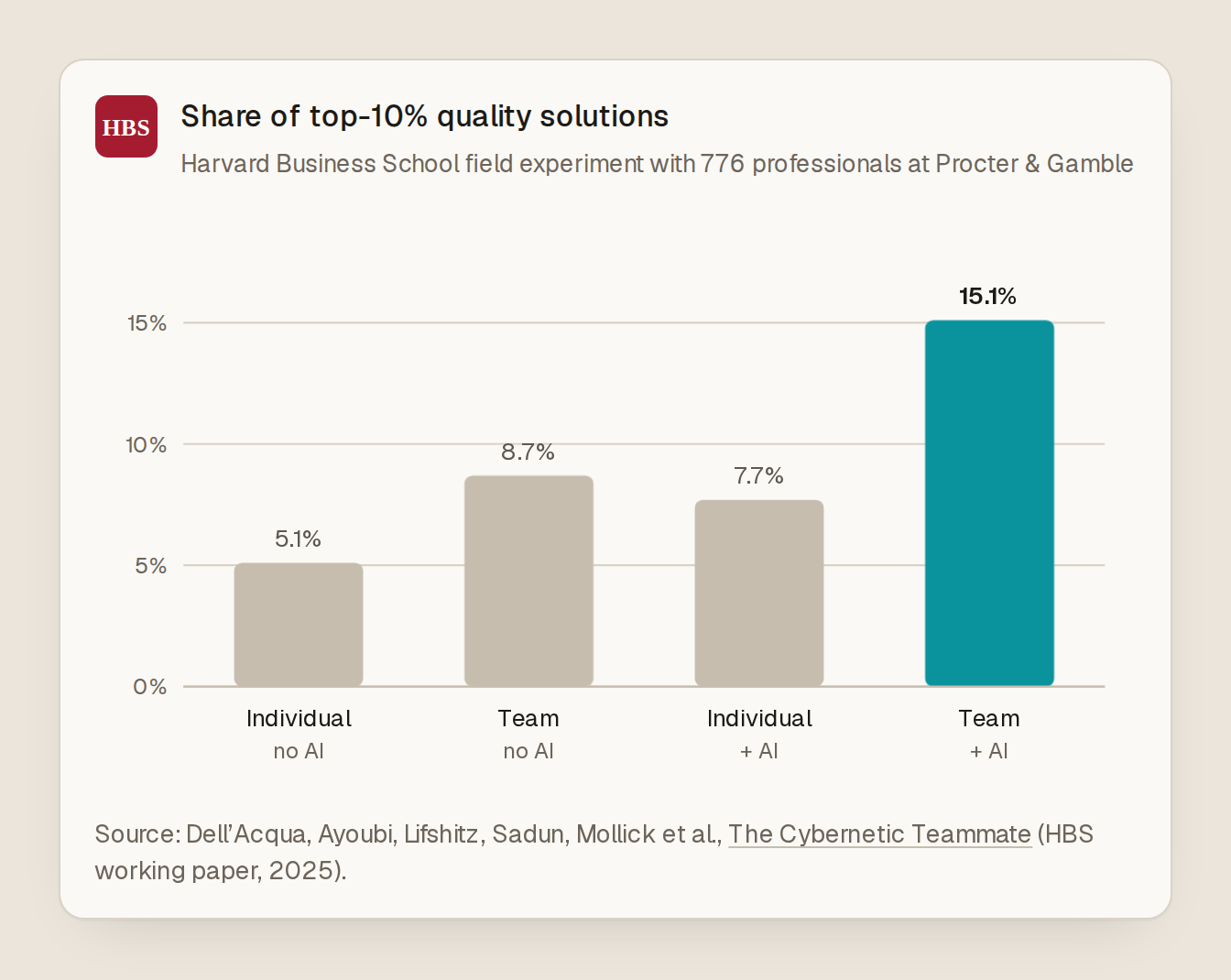
Accordingly, we believe that the key to unlocking further improvements in organizational productivity is to make AI fundamentally multiplayer.
A simple example
For example, a coding agent session that a software developer used to build a new feature in a team's software product should be exactly the same session that the code reviewer can ask questions to. Both developers should be in the same agent chat, and the agent should have access to the exact same tools the developers have: GitHub, Slack, Notion, etc.
This illustrates the first principle in our manifesto: "Never copy-and-paste." Let's get to all the principles now.
The five principles for multiplayer AI
- Never copy-and-paste. Agents should live next to the work, so sharing context is never a manual step.
- Work with the door open. Private sessions keep good practices from spreading.
- Continuously improve. Every correction should become a skill the next agent can reuse.
- People are not routers. Chasing status updates and relaying answers are jobs for agents.
- Nothing starts from scratch. New teammates should be able to pick up the work without reconstructing its history.
Each one has a longer argument behind it, with the research and the examples, in the manifesto itself.
Important considerations
We also list some important considerations for any team that is looking to upgrade their AI deployment.
One such consideration is that multiplayer AI requires agents to work in the cloud, not on employee laptops. We explain why, and note some tricky security and data privacy concerns — things that are important whether you decide to build an internal solution, deploy an open-source solution, or pay for a managed solution.
This manifesto is just the start
No existing solution satisfies the entire manifesto today. But it's a useful North Star to build toward, for us and — we hope — for others, too.
I invite you to read The Multiplayer AI Manifesto. Tell me what you think, what is missing, and where you think we got it wrong. Finally, if we can help you answer questions about your own multiplayer AI journey, grab a time with us.