
We added Factory Droid as a coding-agent integration in Superconductor.
If your team already likes and uses Factory, you can now bring Droid into the same Superconductor workflow you use for the rest of your agents. Add a Factory key in Project Settings or Workspace Settings, then launch Droid from the normal implementation flow alongside Claude Code, Codex, OpenCode, Grok Build, and the rest.
The nice part is that Droid is not just another model selector. It is a different agent harness, with its own behavior and tool loop. That makes it a good candidate when you want a genuinely different implementation to compare, not just the same style of agent pointed at another model.
It also gives you another useful input for benchmarking agents on your own codebase: a Factory-run branch you can measure against Claude Code, Codex, Cursor, OpenCode, and the rest of your agent pool.
Available Models
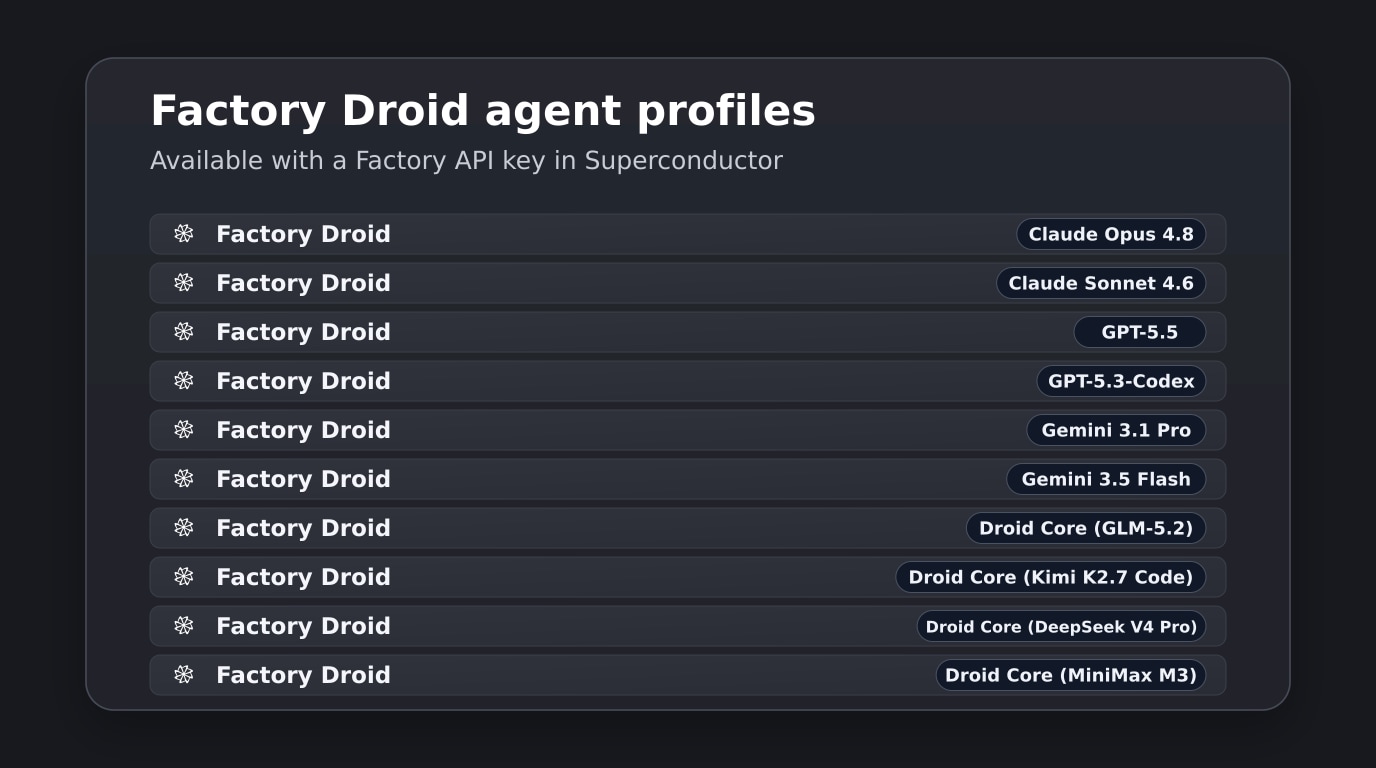
The Factory Droid profiles include Claude Opus 4.8, Claude Sonnet 4.6, GPT-5.5, GPT-5.3-Codex, Gemini 3.1 Pro, Gemini 3.5 Flash, plus Droid Core profiles for GLM-5.2, Kimi K2.7 Code, DeepSeek V4 Pro, and MiniMax M3.
Benchmark
We ran Factory Droid on a Personal SWE-Bench built from 12 ground-truth pull requests in Superconductor's Rails codebase.
Droid Core (GLM-5.2) is interesting here because it lands at the very low-cost end of the chart while still producing a real comparison point. That is the kind of tradeoff benchmarks are good at surfacing: whether a lower-spend branch is good enough for a given class of ticket before you reach for heavier agents.
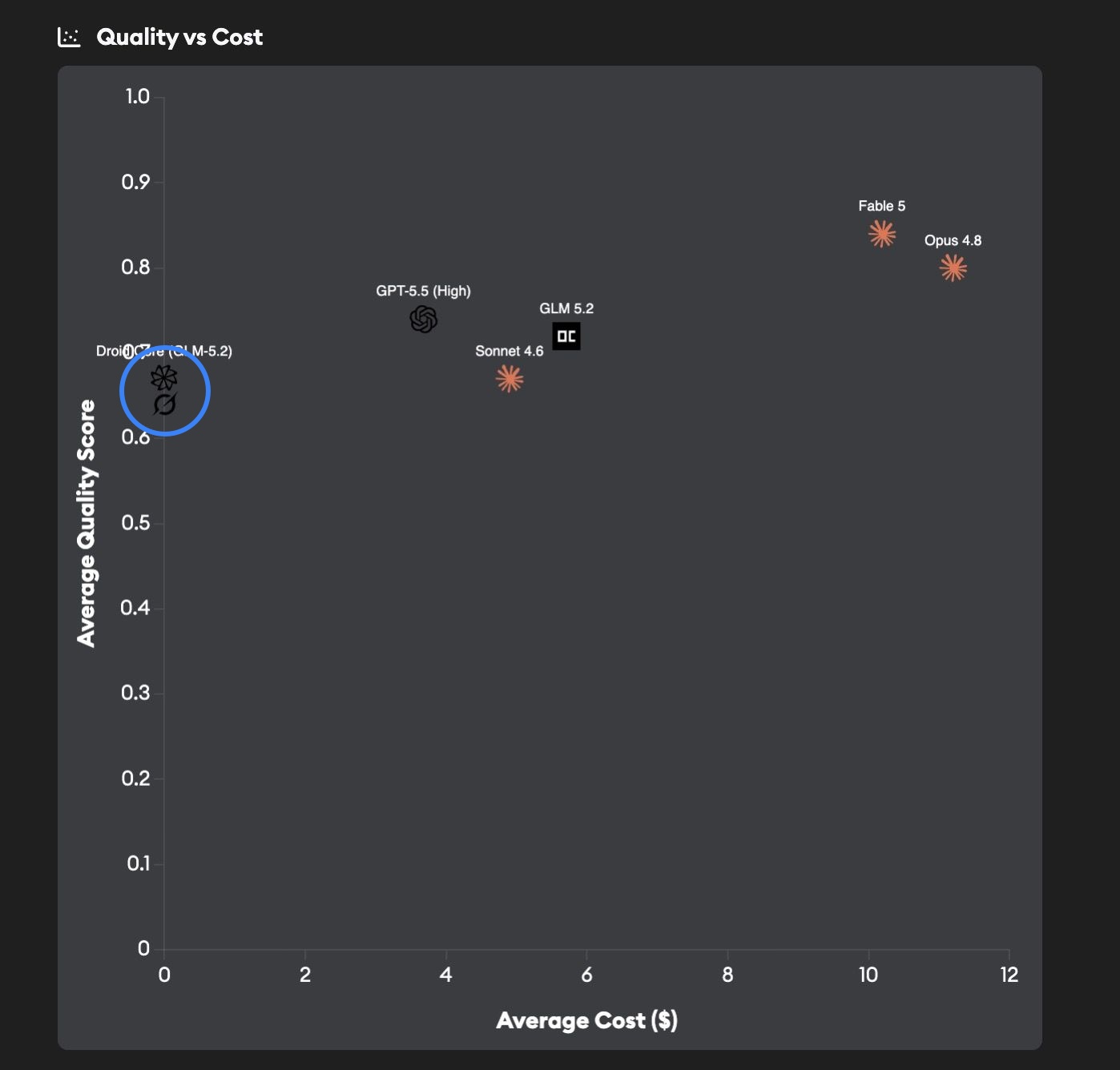
You can run the same kind of comparison on your own repo. Pick merged pull requests your team is proud of, run your agent pool against inferred versions of those tickets, and compare quality, time, and cost on work that actually looks like your work.
Are there any other coding agents you would like to try out in Superconductor? Let us know.