Sentry
Let agents inspect production errors and Sentry issue context.

Sentry MCP lets agents query your Sentry account directly. Agents can look up real errors with stack traces, request data, releases, and user context.
What agents can do
Once you connect Sentry, agents can:
- Find recent issues in your Sentry organizations and projects
- Read stack traces and event details
- Compare releases and suspect commits
- Triage issues: assign teammates, resolve, and update status
- Use production error context while fixing bugs
Setup
Go to Workspace Settings → Connectors (or a project's Connectors page) and click Connect on the Sentry card (or Connect another to add another account).
Step 1: who the connection is for
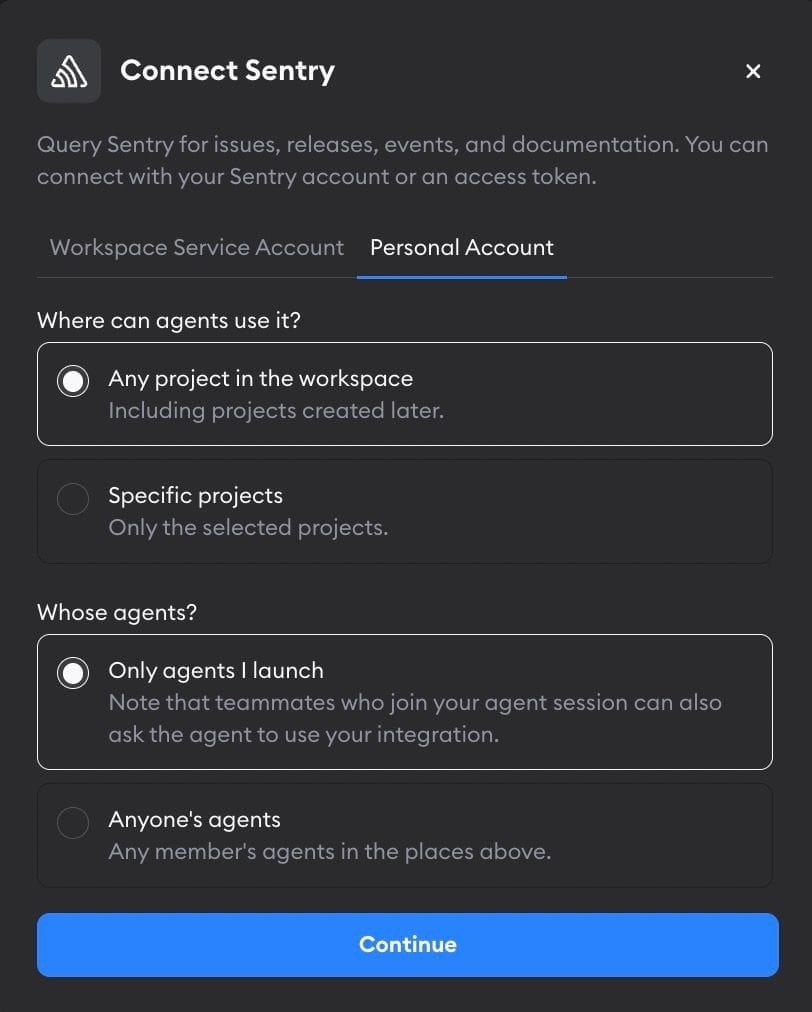
Choose whether the connection belongs to you or to your team, which projects can use it, and whose agents can use it. Sentry starts on Personal Account. See connection options for what each choice means.
Click Continue.
Step 2: how agents reach Sentry
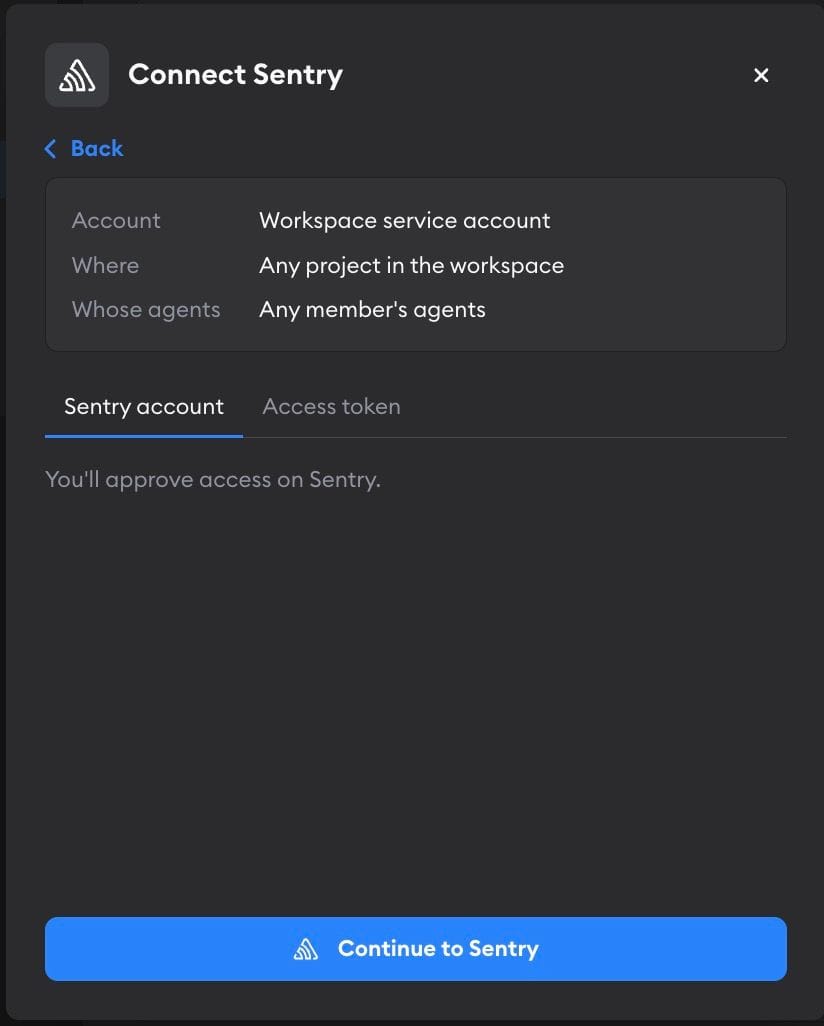
The second screen has two tabs: Sentry account and Access token. Pick one.
Sentry account
This tab is selected by default, and it's the easiest way in — there's no token to create.
Click Continue to Sentry. Sentry asks you to approve access, and you can choose the individual permissions to grant on its approval screen. Approve, and you land back on the Connectors page with Sentry connected.
Agents then reach Sentry with the access of whoever signed in, so they see exactly the organizations and projects that person can. If you picked Workspace Service Account in step 1, everyone's agents use that access — so sign in with an account whose permissions you're happy to share.
If you change your mind on Sentry's screen, you'll come back with Sentry connection cancelled and nothing is saved.
Access token
Use this tab if you'd rather not sign agents in as yourself, or you want to hand them a token with narrower permissions.
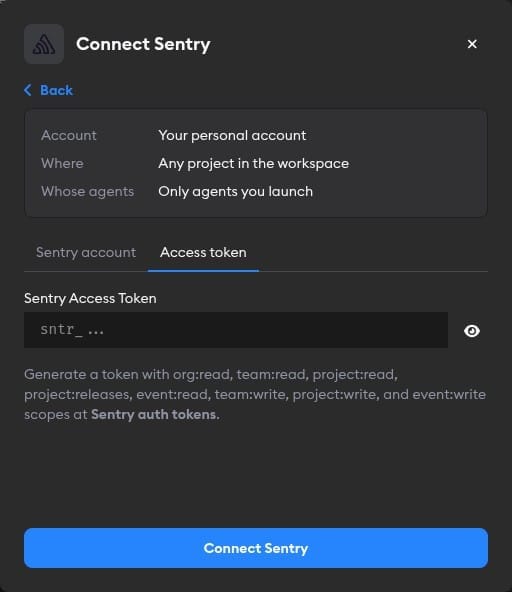
Generate a token at sentry.io/settings/account/api/auth-tokens.
Recommended scopes for full Sentry MCP compatibility:
org:read, team:read, project:read, project:releases, event:read, team:write, project:write, event:writePaste it into the Sentry Access Token field and click Connect Sentry.
Reconnecting and disconnecting
If Sentry stops accepting a connection, the Connectors page shows a Reconnect needed badge on it, and agents run without Sentry.
Click Manage next to the connection to fix it. A connection you made with Sentry account has no key to replace: it shows Account connection: Connected and, when something's wrong, a Reconnect Sentry button. You can only reconnect a personal connection you own; for someone else's, Superconductor tells you who to ask.
Disconnect also revokes Superconductor's access at Sentry. If Sentry doesn't confirm the revocation, Superconductor tells you to remove Superconductor from your Sentry authorized apps to finish the job.
When to use it
Ask agents to use Sentry when a ticket references a production error, stack trace, crash, affected user, or release regression.