Connectors
Connect your team's tools so agents can use your docs, issues, designs, and more.
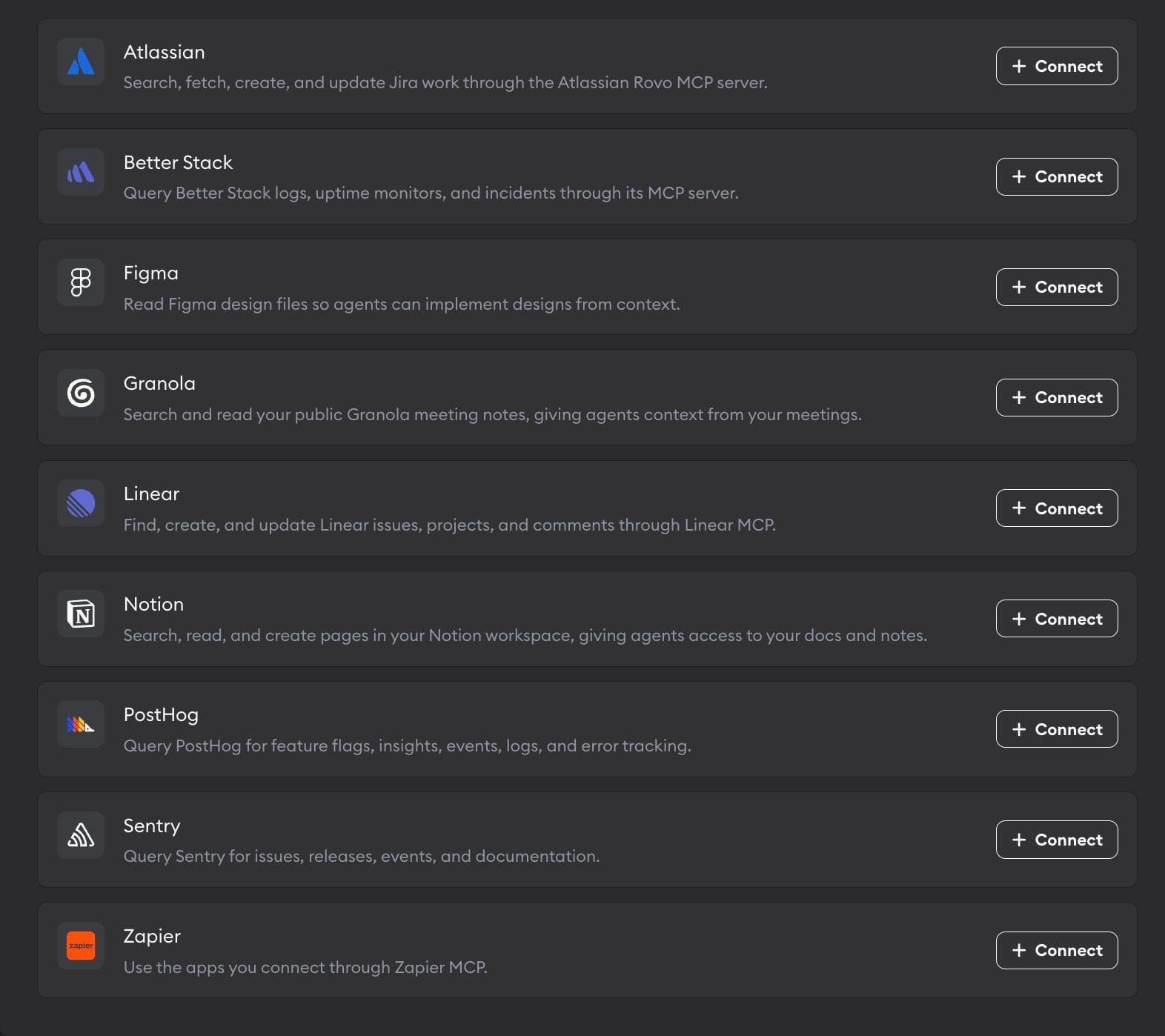
Connect tools such as Notion, Jira, and Figma so agents can use your docs, issues, and designs. Go to Workspace Settings → Connectors to get started.
Connect your tools
Under Connectors, click Connect next to the tool you want to add. If someone has already connected an account for that tool, click Connect another to add yours.
Your team only needs to add a shared connection once, under Workspace Settings. Workspace members with the Owner, Admin, or Collaborator role can add team or personal connections. Viewers can manage personal connections they already own, but can’t add new ones.
Fill in the connection details
Here's an example for Atlassian, which connects agents to Jira:
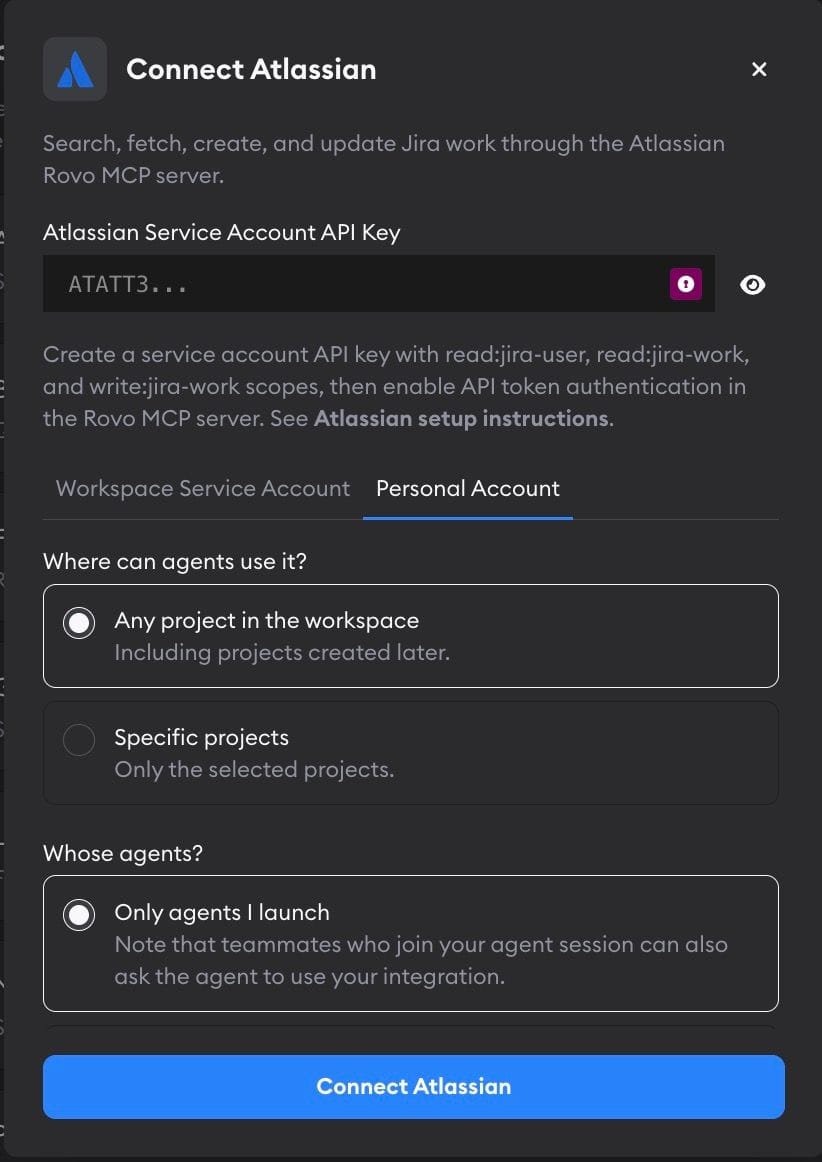
This example connects a personal Atlassian account for agents you launch in any project. You can choose specific projects or share the connection with your team.
Work through the form from top to bottom:
-
API key or token: Paste the key for the tool you're connecting. The label tells you which kind you need—for example, Atlassian Service Account API Key. Follow the setup link beneath the field for help creating a key with the right permissions.
-
Account type:
- Workspace Service Account: Share the connection with your team. Anyone on your team can launch agents that use this connection in the projects you select below. The connection stays with the workspace if the person who added it leaves.
- Personal Account: Choose this if you want the connection to belong to only you. Personal connections are removed when their owner leaves the workspace.
-
Where can agents use it? Choose Any project in the workspace to include all projects, including ones you create later. Or choose Specific projects, then check the projects that need this tool.
-
Whose agents? This field appears when you choose Personal Account:
- Only agents I launch: Your connection will only work in chats or implementations you create. Teammates who join your chat or implementation can also ask the same agent to use your connection.
- Anyone's agents: Anyone on your team can launch agents that use your personal connection in the selected projects.
If everything looks good, click Connect.
Personal account example
Mark connects a Figma API key (a personal access token), chooses Only agents I launch and asks an agent to build a landing page from a Figma design. Alice can join that chat and ask the same agent to refine the landing page. She can't use Mark's connection in a chat or implementation she starts herself.
If Mark chooses Anyone's agents, Alice and other teammates can also use his connection in their own chats and implementations, within the projects Mark selected.
Superconductor stores your keys encrypted. Agents can only do what the account you connect has permission to do in that tool. For example, if your Notion connection can read a doc but can't edit it, agents will also have only read-only access to your Notion docs.
Once a tool is connected, just mention it to your agents in a ticket or chat. For example, connect Notion for your web project, then ask an agent: “Read our checkout spec in Notion and use it to plan this ticket.”
Review your connections
After connecting a tool, you'll see an entry for the account on Workspace Settings → Connectors. You can connect more than one account for the same tool. For example, multiple workspace members can connect their personal accounts for a tool. See Which connection agents use to learn how Superconductor chooses an account when multiple accounts are connected for the same tool.
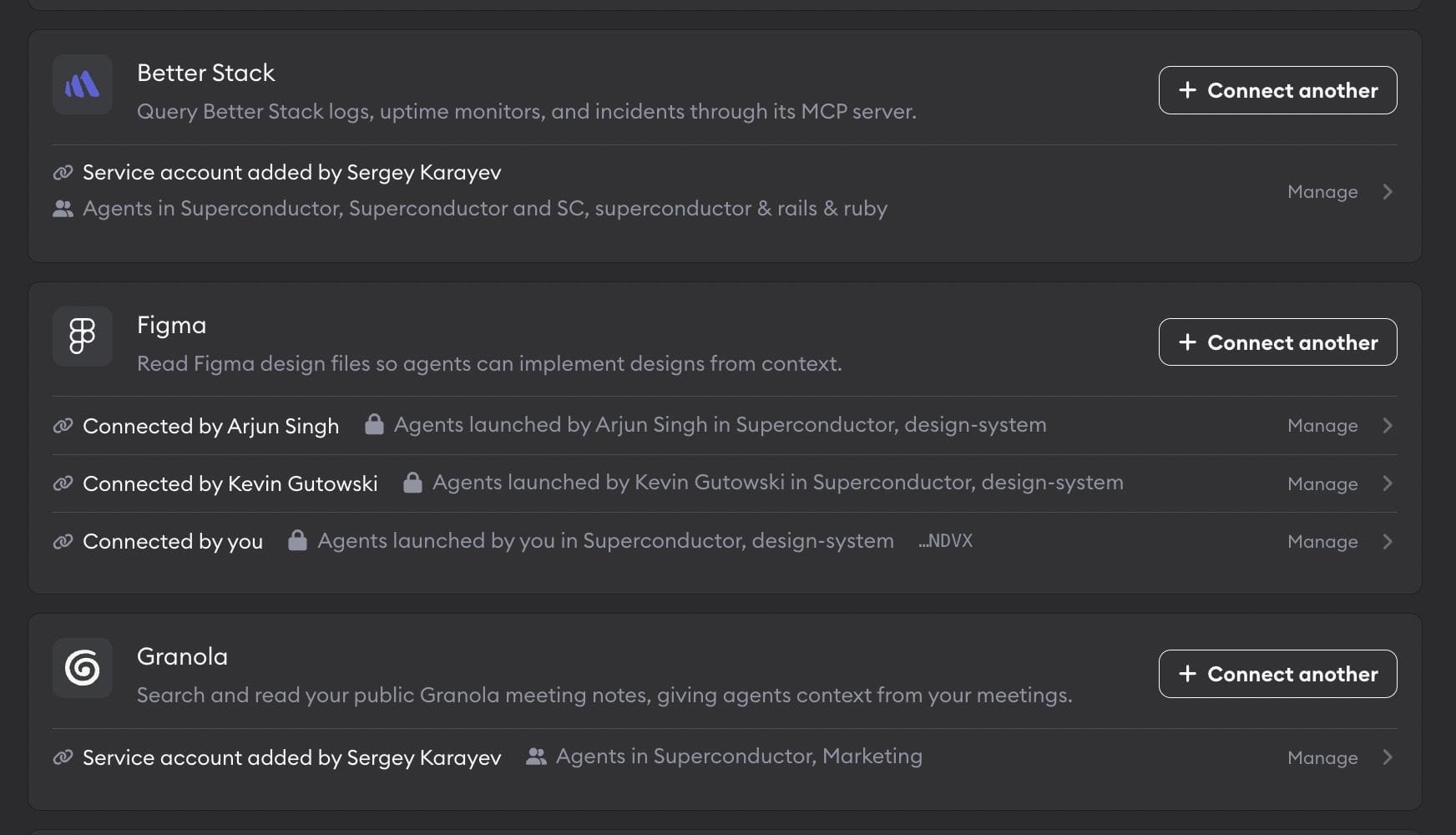
In this example, Sergey added one shared team connection each for Better Stack and Granola. They have different project lists. Figma has separate personal connections for Arjun, Kevin, and the current user, each limited to agents started by that person.
What the icons mean
The text beside each icon tells you who added the account and where agents can use it:
| Icon | What it means |
|---|---|
 Link Link | Who added the account. Service account added by… means it belongs to the workspace. Connected by… identifies the owner of a personal connection. |
 People People | The projects in the workspace where this connection can be used. Any project means the whole workspace. |
 Lock Lock | Only agents started by the named person can use this connection, in the projects listed beside the icon. |
 Plus Plus | Connect adds an account. Connect another adds another account for the same tool. |
Which connection agents use
What happens when multiple accounts are connected for the same tool? If your personal connection is available in the project, your agents use it ahead of a team connection. For example, your agents can use your Figma account while your teammates' agents use the team's account.
Superconductor chooses the account for the person who starts the chat or implementation. Joining someone else's session doesn't switch the connection to yours.
If you don't have a personal connection available in the project, your agents can use a team connection or a personal connection shared with Anyone's agents. They can't use someone else's Only agents I launch connection.
When several connections are available in the project for the same tool, Superconductor picks one in this order:
- Your personal connections come first.
- Among those, Only agents I launch comes before Anyone's agents.
- A connection shared with a specific project comes before one shared with the whole workspace.
- If there's still a tie, the oldest connection wins.
New implementations started by scheduled automations or automations triggered by a pull request merge use connections shared with Anyone's agents, including team connections. These automatic runs won't use a connection you limited to Only agents I launch. If no connection is available, the agent continues without that tool. Some agents have limits on the tools they support; check the tool's guide for details.
Managing connections
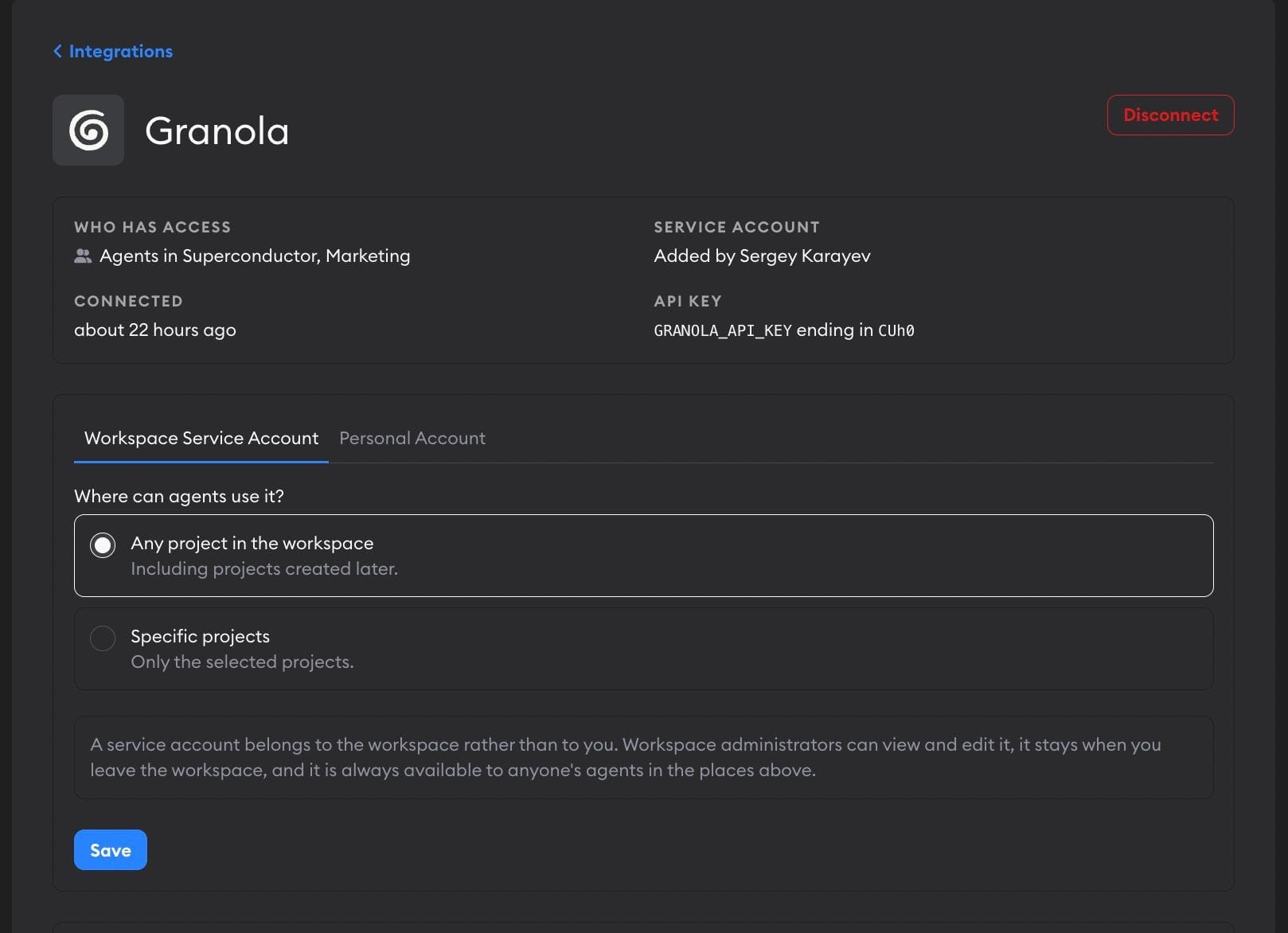
Go to Workspace Settings → Connectors and click Manage next to the connection. The page shows who added the account and who can use it. You can change the projects or sharing options and click Save. To replace the API key, enter the new key in the API key section and click its Save button.
To stop sharing a connection with one project, choose Specific projects and select only the projects that should keep it. Disconnect removes the connection for every project using it.
Any workspace member can manage their own personal connections. Workspace Owners and Admins can manage team connections, as can the person who added one as long as their workspace role is Collaborator or above. Owners and admins can also remove personal connections or change how shared personal connections are used, but they can't view or edit someone else's personal key.
Already working inside a project?
You can also open Project Settings → Connectors to see the connections available there, add one for This project, or click Manage to change an existing connection. The Used by your agents badge shows which account agents you launch in that project will use for each tool.
Tools you can connect
Choose a guide for help getting the API key or token for each tool:
| Tool | What you can ask agents to do |
|---|---|
| Jira (Atlassian) | Look up issues, create follow-up work, and update statuses |
| Better Stack | Search logs and investigate incidents |
| Figma | Read a design and build UI to match it |
| Granola | Find decisions and context in public meeting notes |
| Linear | Find, create, and update issues and projects |
| Notion | Read specs, search docs, and write up findings |
| PostHog | Check analytics, feature flags, events, and logs |
| Sentry | Investigate errors and stack traces |
| Zapier | Work with the apps and actions you choose in Zapier |
Looking for something else?
For browser testing (Playwright) or Superconductor Media Skills for images, video, and audio, go to Project Settings → Skills and MCPs. See Skills and MCP Servers for those options.
You can also add custom MCP servers to connect agents to other tools, or custom skills to give them your own instructions and workflows. Add these to your project's repositories so agents can use them.
Let us know which tools you'd like to connect next!