Superconductor Docs

MCP servers and skills

Extend your agents with Model Context Protocol servers and Agent Skills.

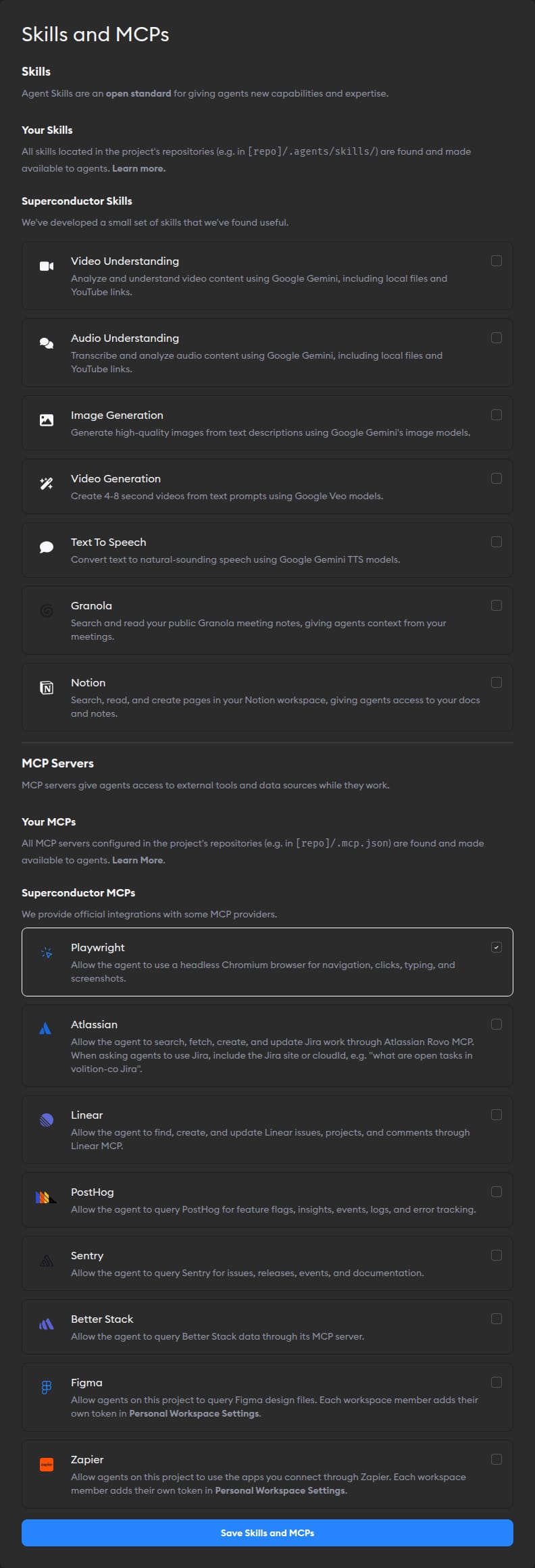
Skills and MCPs overview in Project Settings

MCP servers and skills extend what your agents can do. MCP servers add external tools and data sources (browsers, error trackers, analytics). Skills let agents work with other modalities — video, audio, images, and speech. Both are configured in Project Settings and apply to every agent in the project.

MCP servers

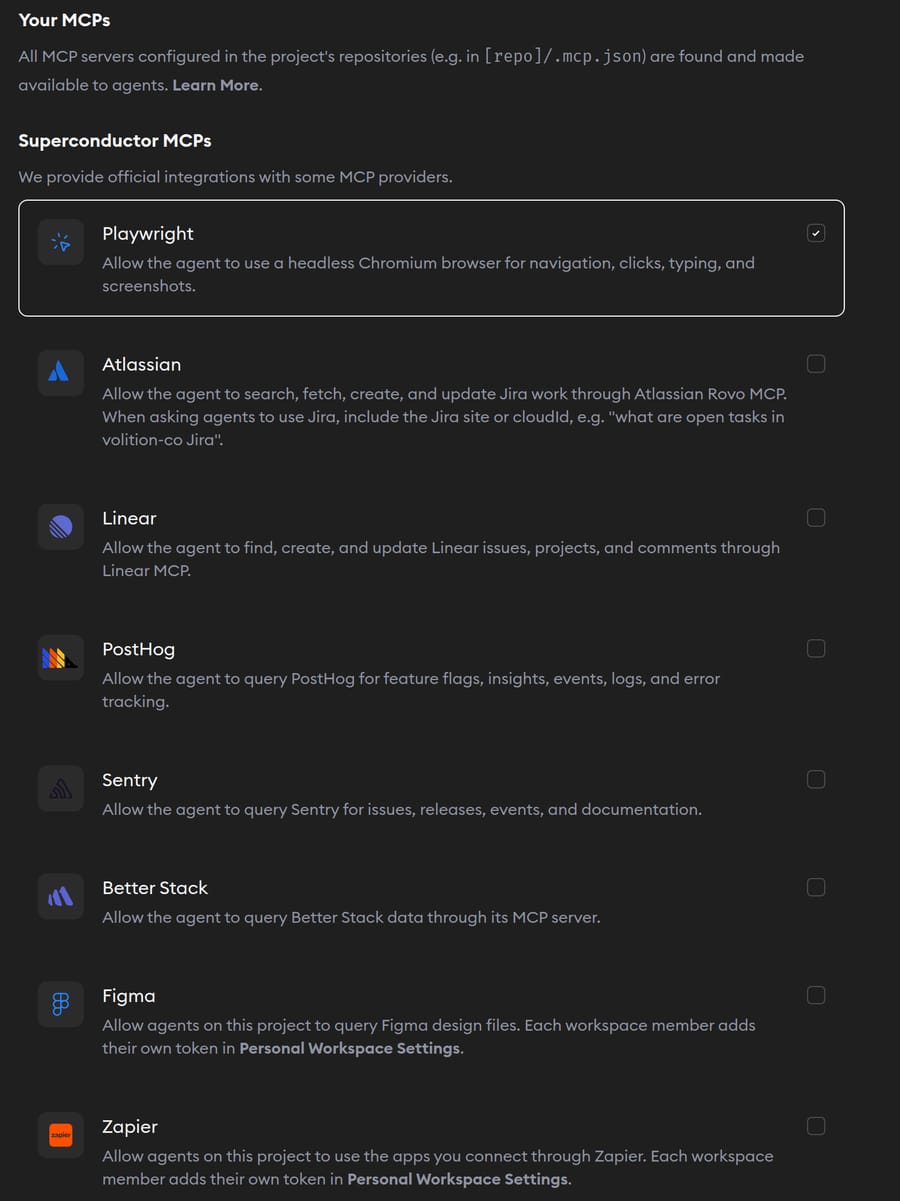
MCP servers in Project Settings with Playwright, Sentry, and PostHog MCP toggles, plus token fields for Sentry and PostHog

Configure Model Context Protocol (MCP) servers to extend agent capabilities with custom tools and integrations. MCP servers allow agents to interact with external services, databases, and APIs during implementations. MCP server settings apply to all agents.

Playwright MCP

Playwright MCP gives agents the ability to control a headless browser. With it enabled, agents can:

  • Navigate to your app's live preview
  • Click links and buttons, fill out forms
  • Take screenshots of the UI and send them back to you in the chat
  • Check the JavaScript console for errors

This is useful when you want agents to verify that UI changes actually work. Instead of trusting that the code looks right, the agent can test it in a real browser and see what users would see.

Screenshots taken by agents appear as Artifacts in the chat. This makes it easy to review visual changes without running the app yourself.

To enable: Go to Project SettingsSkills and MCPsEnable Playwright MCP.

Sentry MCP

Sentry MCP lets agents query your Sentry account directly. With Sentry MCP enabled, agents can look up actual errors with full stack traces, request data, and get user context.

To enable:

  1. Go to Project SettingsSkills and MCPsEnable Sentry MCP
  2. Add your Sentry Access Token
    • Generate a token at sentry.io/settings/account/api/auth-tokens
    • Recommended scopes for full Sentry MCP compatibility: org:read, team:read, project:read, project:releases, event:read, team:write, project:write, event:write

Your token is stored encrypted and only passed to agents when Sentry MCP is enabled.

PostHog MCP

PostHog MCP lets agents query your PostHog account directly. With PostHog MCP enabled, agents can look up feature flags, insights, events, logs, and error tracking data — useful for debugging issues or understanding how a feature is being used in production.

To enable:

  1. Go to Project SettingsSkills and MCPsEnable PostHog MCP
  2. Add your PostHog Personal API Key

Your key is stored encrypted and only passed to agents when PostHog MCP is enabled.

Custom MCP servers from your repos

Superconductor supports project-scoped MCP configuration stored in your repos. If your repo contains an MCP config file, Superconductor merges it into the agent's MCP configuration automatically. This lets you version-control MCP servers alongside your code so every agent gets the same tools without manual setup.

Each agent reads from its own config file format:

AgentMCP config fileOther merged config
Claude Code[repo]/.mcp.jsonHooks, plugins, and marketplaces from [repo]/.claude/settings.json; commands and agents from [repo]/.claude/
Codex[repo]/.codex/config.toml
Gemini CLI[repo]/.gemini/settings.jsonCommands
OpenCode[repo]/opencode.jsonCommands, agents, plugins
Amp[repo]/.amp/settings.json

When there are conflicts between your repo config and the config Superconductor generates (e.g., from MCP servers enabled in Project Settings), Superconductor's config takes precedence.

Skills

Skills section of Project Settings showing Video Understanding, Image Generation, Audio Understanding, Video Generation, and Text To Speech toggles with a note that selected skills make requests to Gemini

Skills are built on an open standard and work with any Superconductor agent. Enable them from Project SettingsSkills and MCPs. Once a skill is enabled, just ask your agent in the chat to generate an image, analyze a video, etc, and agents will use the relevant skill.

Available skills

  • Video Understanding - Analyze videos up to an hour long. Supports local files (mp4, mov, webm, avi, mkv) and YouTube links.
  • Audio Understanding - Transcribe and analyze audio up to 9.5 hours long. Supports mp3, wav, m4a, ogg, flac, and YouTube links.
  • Image Generation - Generate images from text descriptions. Can use existing images or videos as style references.
  • Video Generation - Create 4-8 second videos from text prompts. Supports image-to-video animation with native audio.
  • Text to Speech - Convert text to natural-sounding speech. 30 voices, 24 languages, automatic language detection.

All skills require a Google Gemini API key configured at the workspace or project level.

Custom skills from your repos

You can also add custom skills by including them in your repo. Superconductor picks up agent-specific skill directories and makes them available:

AgentSkills directories
Claude Code[repo]/.claude/skills/ or [repo]/.agents/skills/
Codex[repo]/.codex/skills/ or [repo]/.agents/skills/
Gemini CLI[repo]/.gemini/skills/ or [repo]/.agents/skills/
OpenCode[repo]/.opencode/skills/ or [repo]/.agents/skills/
Amp[repo]/.agents/skills/

The [repo]/.agents/skills/ path is part of the Agent Skills open standard and works across all agents. If multiple repos define a skill with the same name, the first repo (alphabetically) wins.

Skills use cases

Some examples of what you can do with Agent Skills:

  • Create visual database structure diagrams automatically
  • Analyze competitor demo videos to produce competitive analysis reports
  • Generate multiple landing page redesign mockups from text descriptions
  • Identify bugs from customer call recordings
  • Extract customer testimonials from YouTube videos for your website

On this page